Read It, Flip It, Win It: The Real-Time Chess Match That Decides Who Hoists the Trophy
There's a moment in almost every high-stakes playoff game where you can feel it — the shift. The crowd senses it before the announcers call it. One team's body language tightens, the other loosens up, and suddenly a game that looked decided starts tilting the other direction. Most fans chalk it up to momentum, to runs, to the basketball gods doing their thing. But spend any real time studying what's happening on those sidelines, and the picture gets a lot clearer. Somebody made a decision. Somebody saw something, adjusted, and changed the game.
That invisible pivot is the most underrated weapon in professional basketball. And the teams that have it — really have it — are the ones cutting down nets in June.
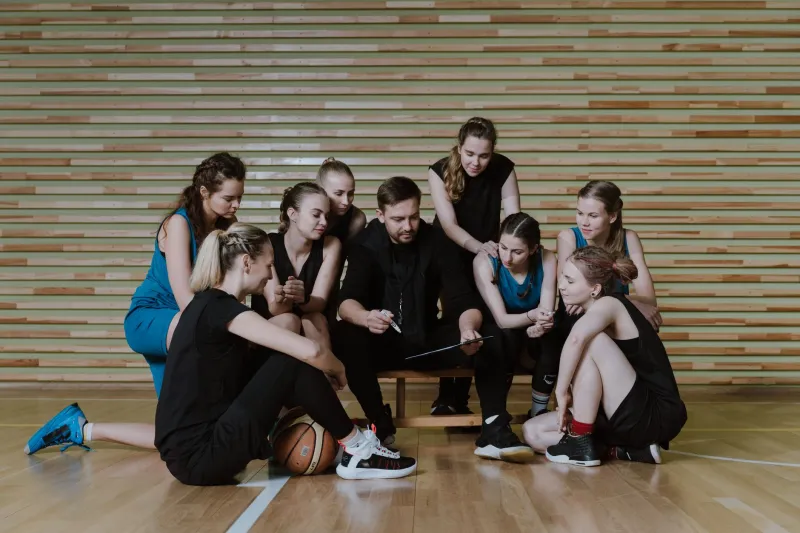
The Timeout Huddle Is a War Room
When a coach calls timeout with his team down eight in the third quarter of a playoff game, the clock doesn't stop for his brain. He's already processing: What's their defense giving us? Why did our pick-and-roll coverage break down three possessions in a row? Is our star getting tired or is he just getting bad looks? Do we need a personnel change or a schematic one?
All of that, in roughly 60 seconds, while also keeping five competitive, adrenaline-charged athletes calm and focused.
The best coaching staffs in the league treat those huddles like a live film session compressed into a minute. They're not delivering motivational speeches — they're delivering information. Specific, actionable, targeted information. "Their center is cheating off the weak side. We're going to attack that twice in a row and see if they adjust." That's the kind of language that wins playoff games.
Coaches like Erik Spoelstra in Miami have built entire reputations on this skill. The Heat have repeatedly been written off mid-series, mid-game, sometimes mid-quarter, only to come out of timeouts running something completely different that their opponent hadn't prepared for. It's not magic. It's preparation meeting real-time recognition.
The Cat-and-Mouse Game Nobody Talks About
Here's what makes mid-game adjustments so fascinating: they're not one-sided. The moment one coaching staff flips a wrinkle, the other staff is watching, cataloging, and plotting a counter. It's a living, breathing chess match happening at full speed, with 20,000 people screaming and a billion-dollar franchise hanging in the balance.
During Boston's recent playoff runs, Joe Mazzulla and his staff have shown a willingness to toggle between defensive schemes in ways that genuinely confuse opposing offenses. They'll play drop coverage for a quarter, switch to a hedge, then go under screens — all within the same game. The point isn't randomness. The point is that the opponent's point guard can't settle into a rhythm because the answer keeps changing before he can figure out the question.
On the flip side, teams that get caught in adjustment loops — changing too much, too fast, without conviction — end up in no man's land. Players hate uncertainty. Nothing kills execution faster than a guy second-guessing the scheme while he's supposed to be setting a screen.
The art is knowing when to flip the script and when to stay the course. That judgment call, more than any individual talent on the floor, is what separates coaches who win titles from coaches who win regular season games.
When Stubbornness Becomes a Death Sentence
For every Spoelstra timeout adjustment that becomes a Reddit highlight, there are ten examples of coaches who looked at a failing game plan and just... kept running it. It's one of the most baffling and consistent patterns in playoff basketball. A team's primary ball-handler is getting bodied at the point of attack, their opponent has clearly figured out the offensive action, and instead of pivoting, the coaching staff keeps calling the same play and hoping the execution improves.
Sometimes it's ego. Sometimes it's a misplaced belief that the players just need to "execute better." Sometimes it's genuine uncertainty about what to run instead. But whatever the reason, the cost is almost always the same: momentum bleeds out, the lead evaporates, and by the time the adjustment finally comes, it's too late to matter.
The 2023 Denver Nuggets were a masterclass in the opposite approach. Mike Malone and his staff were relentless about in-game problem-solving. When something wasn't working, they acknowledged it fast. When Nikola Jokic was being doubled aggressively, they found new angles to create before defenses could set. When their transition defense got exploited, they made personnel tweaks that looked subtle from the outside but completely changed the coverage responsibilities. That adaptability didn't just help them win games — it helped them win a championship.
The Pressure Cooker Nobody Signed Up For
Let's not gloss over the human element here, because it matters. These are real people making real decisions under conditions that most of us will never experience. When LeBron's team is down three with six minutes left in Game 5, and the coach has to decide whether to go small or stay big, whether to switch everything or stay in zone, whether to call timeout now or save it — he's doing all of that with his job, his legacy, and his players' seasons riding on the call.
The psychological pressure of that moment is enormous. And yet the best coaches somehow find a way to stay analytical. To block out the noise. To trust what they're seeing over what they're feeling.
Assistant coaches play a massive, underappreciated role in this. The guy in the headset talking to the bench, the analytics staffer feeding real-time data on shot quality and defensive positioning, the video coordinator who had a specific clip ready at halftime — all of them are feeding information to the head coach so he can make faster, better decisions. It's a team effort that fans never see.
Why Some Teams Just Get It
Culture is the unsexy answer, but it's the right one. Teams that consistently execute mid-game pivots have usually built a culture where players trust the staff enough to buy in immediately when something changes. There's no "why are we running this?" hesitation. There's no veteran quietly ignoring the new wrinkle because he's been in the league twelve years and thinks he knows better.
That buy-in is earned over months and years of honest communication, film study, and coaches proving to players that their adjustments work. When Spoelstra calls a new action in the fourth quarter, his guys run it with conviction because he's shown them — repeatedly — that he sees things they don't.
Building that trust is a long game. But when the playoffs arrive and the margin for error shrinks to almost nothing, teams that have it own a massive advantage over teams that don't.
The invisible pivot isn't invisible at all, really. It's just happening too fast for most fans to catch in real time. Slow it down, rewatch those timeout sequences, track the defensive scheme changes across quarters — and suddenly you can see exactly where championships are won and lost. Not in the final buzzer moment. In the quiet, urgent huddle two minutes before it.