The Role Players Running the Show: How Depth Scoring Became the Real Championship Secret
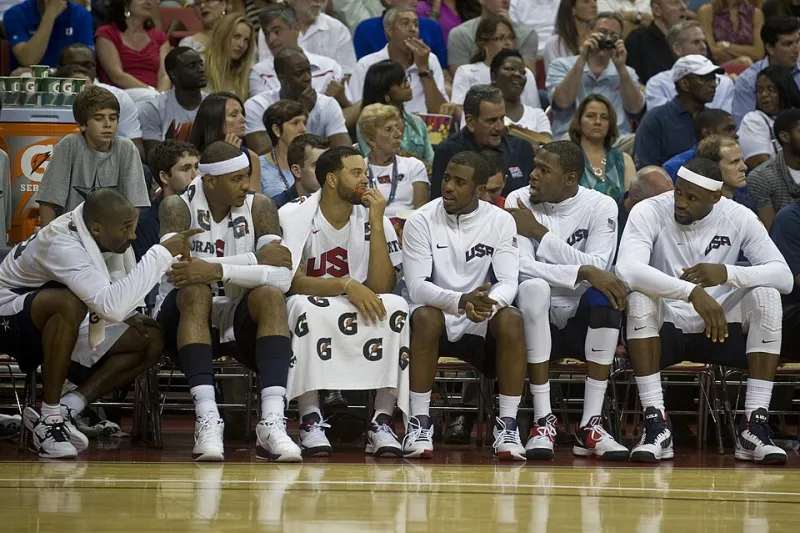
Photo: Airman 1st Class Daniel Hughes/99th Air Base Wing, Public domain, via Wikimedia Commons
Here's a thought experiment. You've got two teams. Team A has a top-five player in the league and a solid supporting cast. Team B has three guys who are each good enough to be a first option on a bad team, and they're all perfectly okay being the third option on a great one. In a seven-game series, which team do you trust?
A few years ago, the answer felt obvious. Star power wins. Load up on talent at the top, surround the guy with shooters, and ride him in crunch time. But the data coming out of recent playoff runs is telling a different story, and the front offices paying attention are already changing how they build.
The third and fourth scoring options — those players who aren't the face of the franchise but can absolutely go off on a Tuesday night in May — have become the most undervalued and increasingly coveted pieces in modern team construction. This is the Bench Mob Effect, and it's reshaping championship DNA from the ground up.
Why the Third Option Matters More Than Ever
Defensive sophistication in today's NBA and NFL has never been higher. Schemes are more complex. Film study is more thorough. Game-planning is more precise. When a defense knows exactly who your second-best player is and has a specific plan to neutralize both your top two threats, what happens next determines everything.
If your answer is "not much," you lose in six. If your answer is "our third option puts up 22 and makes them pay," you're playing in June.
The Golden State Warriors dynasty understood this before almost anyone else. Yes, Steph Curry was the engine. But the reason those teams were so suffocating in the playoffs was that Klay Thompson, Draymond Green, and at various points Andre Iguodala, Kevin Durant, and others could each carry a quarter or a half when the defense shifted its attention. There was no safe defensive decision. Every help rotation created a problem somewhere else on the floor.
That multi-layered offensive threat isn't something you stumble into. It's something you build intentionally.
The Supermax Trap
Here's where a lot of franchises have gotten themselves into trouble over the past decade. They identify a star, pay him a supermax deal, and suddenly 35 to 40 percent of the salary cap is committed to one guy. The remaining roster gets built on minimum contracts, mid-level exceptions, and hope.
The result? A team that can beat anyone on a great night and gets absolutely exposed when the primary star has an off game or gets into foul trouble. The third and fourth options aren't real threats — they're space-fillers. Defenses can afford to ignore them.
Contrast that with teams that have been willing to forgo the single-superstar model in favor of spreading investment across three or four legitimate scorers. None of them are getting $50 million a year. But all of them are getting enough to stay, and collectively they're creating a nightmare for any opponent trying to build a coherent game plan.
The Denver Nuggets' championship run is instructive here. Nikola Jokic is obviously the centerpiece, but what made that team genuinely terrifying in the playoffs was that Jamal Murray could go for 35, Michael Porter Jr. could go for 28, and Aaron Gordon could do the same on any given night. You couldn't scheme against one guy. You had to pick your poison, and every option was bad.
Developing vs. Buying
One of the fascinating subplots in this shift is the question of how teams are acquiring their depth scorers. The old model was to draft a star, sign a second star in free agency, and fill out the rest. The new model increasingly involves investing serious developmental resources into players who are already on the roster.
Teams are getting smarter about identifying players in the 18-to-22 point range — guys who can create their own shot, hit from three, and function within a system without needing the ball in their hands every possession. Those players used to get overlooked because they weren't "the guy." Now they're the most sought-after commodity in the league.
The trade market has shifted accordingly. Contenders are paying real assets for proven secondary scorers in a way that would have seemed strange ten years ago. A player who averages 17 points, shoots 38 percent from three, and doesn't need plays run for him is worth more to a championship-caliber team than almost any other type of player — more than a backup big, more than a defensive specialist, more than a veteran presence in the locker room.
What This Means for the Next Generation of Contenders
If you're a team currently in the middle of a rebuild, the lesson here is pretty clear: don't sacrifice everything for one transcendent talent if the cost is gutting your depth. A roster with two or three genuinely dangerous scorers and strong role players around them is more playoff-sustainable than a team with one superstar and a prayer.
That's not to say stars don't matter. They absolutely do. But the teams that are going to own the next five years of professional basketball are the ones that figure out how to build around their stars rather than just next to them. The third scorer who can be a first scorer when the moment calls for it isn't a luxury anymore. He's a necessity.
Front offices that are still hunting exclusively for the next franchise-altering superstar while neglecting the middle tier of their roster are playing an outdated game. The blueprint has changed. The teams that read it correctly are already stacking the pieces.
Redefining What a Champion Looks Like
Fans love the star narrative. It's easier to market, easier to follow, easier to build a jersey sales strategy around. But what fans have been watching in the biggest games of the past several years tells a different story.
Championships are being won in the third quarter when the starter is on the bench. They're being won by guys who came off the bench in the first half and ended up as the best player on the floor by the fourth. They're being won because when the defense locked in on the obvious threat, someone else was ready.
The bench mob isn't a backup plan anymore. In the most successful organizations in sports right now, it is the plan.